
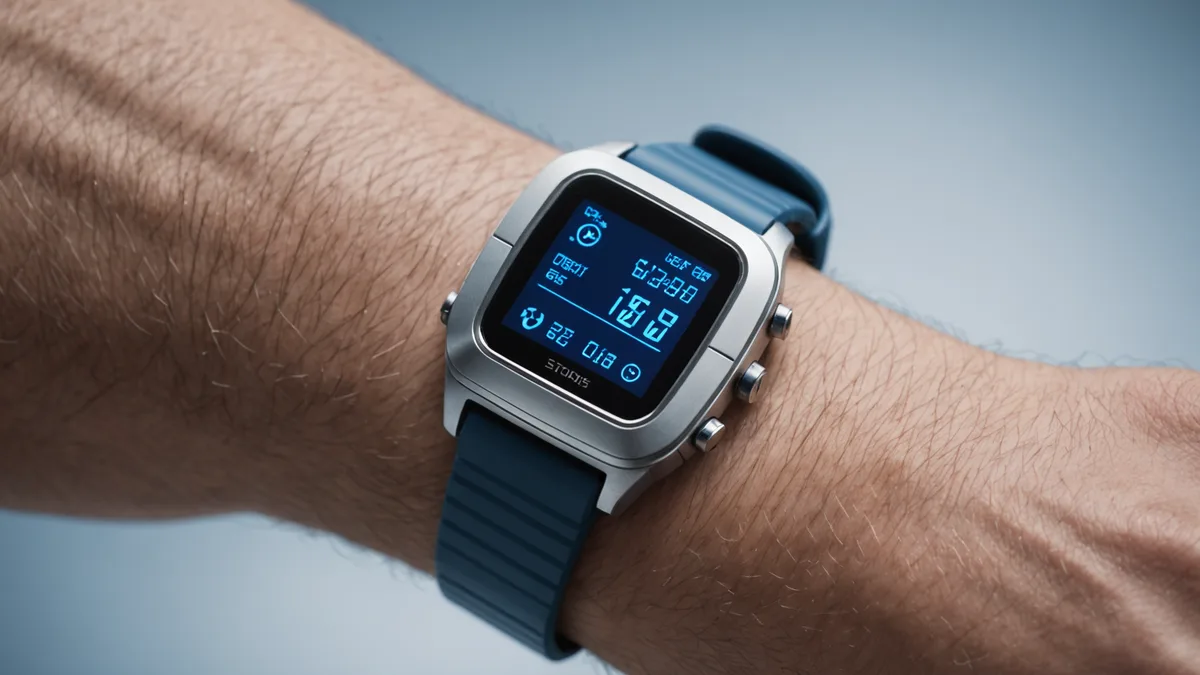
Patients are arriving at preventive care consultations carrying months of biometric data their physicians cannot easily use. The infrastructure gap is real: consumer wearables collect heart rate variability, resting heart rate, sleep staging, SpO2, activity metrics, and temperature variations at a cadence no periodic lab draw can match. But the clinical workflow for receiving, interpreting, and contextualizing this data does not yet exist in most practices.
The result is a familiar dynamic. A patient hands over their phone to show six months of HRV data. The physician glances at it, notes that the numbers look low, and has no efficient way to determine whether the pattern is clinically meaningful or an artifact of measurement inconsistency, the patient's sleep schedule, recent illness, or a dozen other confounders. The consultation moves on. The data sits unused.
Preventive physicians who want to change this pattern need a framework for deciding which wearable signals are worth extracting, under what conditions, and how to connect them to the rest of the patient's clinical picture.
The Fundamental Problem: Continuous Data Meets Episodic Infrastructure
Standard clinical workflows are designed around episodic data. Lab panels are drawn at discrete timepoints. Vitals are measured at visits. Assessments happen during the consultation window. This episodic structure made sense when data collection was labor-intensive and analysis was manual.
Consumer wearables generate continuous data. A modern fitness tracker collects physiological readings at one-minute intervals, 24 hours per day. Over six months, a single patient generates a dataset that would take hours to review manually, even if it arrived in a clinically interpretable format. And it typically does not arrive that way.
The signal-to-noise problem is built into this mismatch. Continuous data contains real clinical signals, but it also contains movement artifacts, device wear inconsistency, algorithm updates that change metric calculations mid-stream, and normal physiological variability that looks alarming when viewed without context. A physician who lacks the time or computational infrastructure to distinguish between these categories cannot use wearable data responsibly.
Which Wearable Signals Have Clinical Weight
Not all wearable metrics carry equal clinical validity for longevity and preventive medicine. The evidence base is still developing, but some signals have accumulated more support than others.
Heart rate variability, specifically RMSSD and related frequency-domain metrics, has a reasonably well-established relationship with autonomic nervous system function and cardiovascular health. Long-term suppression of HRV, observed over weeks to months rather than day-to-day variation, is associated in research literature with increased cardiometabolic risk. A prolonged downward HRV trend is a more meaningful observation than any single night's reading.
Resting heart rate trajectories over months carry similar logic. Day-to-day resting HR variation is normal and multifactorial. A sustained elevation in resting HR over a six-to-twelve week period, particularly in a patient without recent illness, is a different kind of observation and worth correlating against the patient's lab and EMR data.
Sleep architecture metrics (time in deep sleep, time in REM, fragmentation indices) from wearables should be treated with more caution. Consumer devices use photoplethysmography and movement to infer sleep stages rather than EEG. Their accuracy at the individual night level is limited. However, trend data over months, combined with patient-reported sleep quality, can surface patterns worth investigating.
SpO2 from consumer wearables is typically averaged and smoothed, making it poorly suited for detecting episodic nocturnal desaturation without clinical-grade monitoring. A physician should not use wearable SpO2 data to rule out sleep-disordered breathing. A persistent pattern of lower-than-expected readings, viewed in context, can serve as a reasonable prompt to order a formal study.
The Integration Problem Is Upstream of the Interpretation Problem
Even when a physician has decided which wearable metrics are clinically relevant for a given patient, the practical barrier remains: how do you connect those metrics to the patient's lab history, EMR record, and clinical timeline in a form that is usable at the point of care?
A physician who manually downloads a wearable export, compares HRV trend dates against lab draw dates, and tries to correlate metabolic changes with physiological dynamics is doing integration work that does not belong in a clinical workflow. It is slow, error-prone, and not reproducible across a patient panel.
The integration layer needs to align wearable data on the same timeline as the rest of the patient's clinical record. This means normalizing units, handling gaps in device wear compliance, flagging periods of likely artifact, and making the physiological stream readable alongside the biochemical stream. Once alignment exists, the physician can see whether the period of HRV suppression corresponds to the timeframe when fasting insulin was elevated, or whether a resting HR elevation preceded the patient's next scheduled lab draw by two months.
These kinds of temporal correlations are not diagnostic in themselves. They are pattern observations that inform which clinical questions are worth asking and which workups are worth prioritizing. The physician still makes the clinical judgment. The infrastructure makes the pattern visible.
What Not to Do with Wearable Data
The most common mistake in incorporating wearable data into preventive care is treating it as equivalent in precision to clinical-grade measurement. Wearable HRV data drawn from a consumer optical sensor worn on the wrist is not the same as HRV measured from a clinical ECG during a structured protocol. The correlation is meaningful at the population level. At the individual level, the confidence interval is wider.
A physician who orders workups based on a single night of anomalous HRV readings is over-reading the data. A physician who dismisses six months of consistently suppressed HRV because it came from a consumer device is under-reading it. The appropriate posture is to treat wearable signals as probabilistic inputs that raise or lower the pre-test probability of a clinical concern, not as standalone diagnostic criteria.
Similarly, a physician should not present wearable data to patients in ways that imply more interpretive certainty than the data supports. A patient who has been told their HRV is bad without context for what that means, why it varies, and which factors influence it will arrive at the consultation anxious and potentially misinformed.
The Direction Things Are Moving
The clinical infrastructure for receiving and contextualizing wearable data is developing, but unevenly. What is not yet standard is the integration layer that places wearable streams on the same patient timeline as lab chemistry and clinical history, and surfaces the combined picture in a form the physician can use in a 20-minute consultation.
When that layer exists, the physician's task does not become automated. It becomes better supported. The decision about which wearable pattern warrants clinical action, and what form that action should take, remains a judgment call. The data just gets to inform that judgment in a way it currently cannot: not because wearable data lacks clinical relevance, but because the infrastructure for receiving it at the right level of integration has not kept pace with the pace of collection.